Research Topics
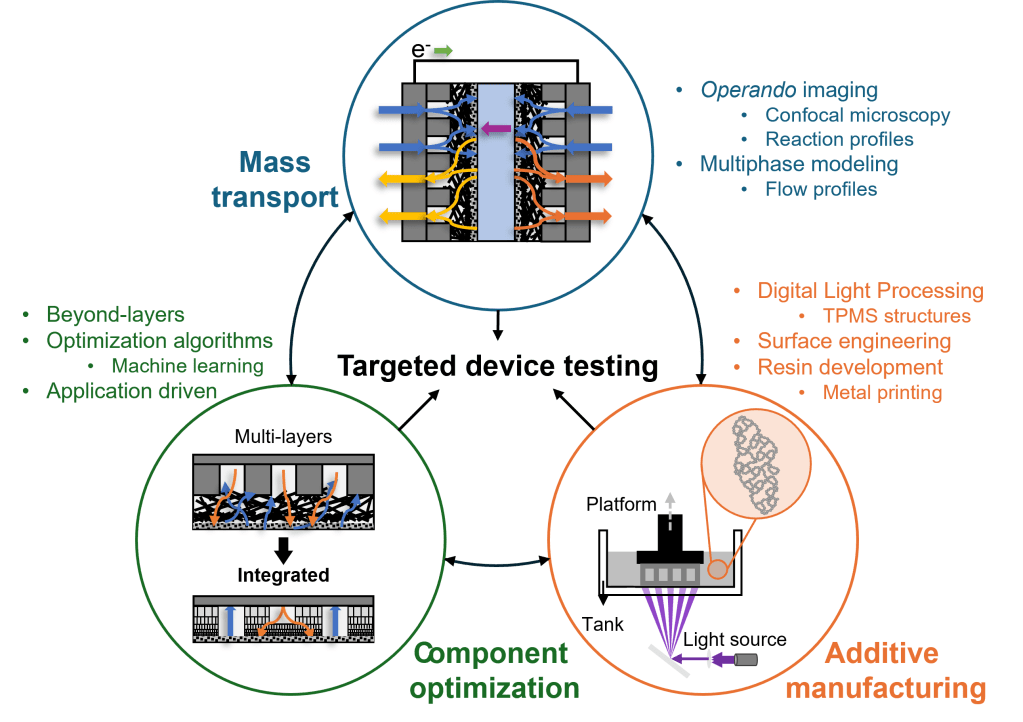
Our research group focuses on the manufacturing of porous materials for electrochemical devices, such as redox flow batteries, water electrolyzers, and fuel cells. Our research bridges the gap between experimental and computational approaches by combining imaging diagnostics, computational optimization, and additive manufacturing strategies. This enables us to design new porous materials tailored to specific reactor designs and operation conditions, ultimately improving the efficiency, durability, and cost-effectiveness of electrochemical devices. Our research concentrates on three interconnected topics:
(1) (Multiphase) mass transport in porous media: Studying the structure-performance relationships in electrochemical devices through imaging diagnostics and computational modeling. Operando, in-situ, and ex-situ imaging diagnostics are utilized to visualize and characterize (multiphase) flow through electrochemical reactors, supplemented by macro- and mesoscale computational approaches, including continuum macroscale fluid dynamic simulations and pore-scale models.
(2) Computational optimization: Designing improved porous materials using strategies such as coupling pore-scale models with machine learning and heuristic algorithms to enhance the charge, mass, and heat transport in the porous media.
(3) Additive manufacturing: Developing enhanced porous materials with controlled structure and properties through various 3D printing approaches, resin engineering, and surface functionalization.
The principles and methodologies developed by our research group can be applied and adapted to a wide range of (electro)chemical devices and manufacturing processes.
Current Projects
(Multiphase) mass transport in porous media
Co-designing flow fields and porous electrodes for redox flow batteries using computational approaches

Advanced Modeling, Optimization, and Uncertainty Quantification of Redox Flow Batteries Using Pore Network Models and AI-Based Approaches

Simulating 3D printed porous electrodes in redox flow batteries using COMSOL Multiphysics
Project alumni:

Project details
COMSOL Multiphysics is well suited for simulating coupled phenomena. For redox flow batteries, this includes fluid flow, mass transport, and secondary or tertiary current distribution. To validate experimental results and reduce the number of required tests, we import different three-dimensional porous electrode structures into COMSOL for analysis. Key metrics of interest include the uniformity of current and concentration distributions, and the pressure drop across the electrode.
Computational optimization
Neural networks for pore network modeling of redox flow batteries

Additive manufacturing
3D printing of porous electrodes for flow electrochemical applications




Project alumni:


Project details
We develop custom porous electrodes using high‑resolution DLP 3D printing, enabling precise control over geometry and internal architecture. Designs are created in CAD or nTop, giving us exceptional flexibility to tailor pore structures, flow pathways, and mechanical properties for electrochemical applications. After printing with a plant‑based resin, the parts are washed and UV‑cured (see video below), then converted into conductive carbon structures by carbonizing the prints in a high‑temperature oven. During carbonization, the prints shrink significantly, yielding finely detailed carbon architectures.
Our DLP printers offer excellent resolution, allowing us to fabricate intricate electrode designs ideally suited for flow electrochemical systems, including redox flow batteries, electrolyzers, and other advanced electrochemical devices.
Performance evaluation of porous electrodes in redox flow batteries


Project alumni:

Designing, manufacturing, and testing of new lab-scale (redox) flow battery concepts


Project alumni:


Project details
In redox flow batteries, efficient electrolyte mass transport is critical to overall cell performance, as maximizing electrolyte delivery to the electrode-electrolyte interface enhances redox reactions and improves electrochemical potential. This research project seeks to create a new electrolyte diffuser design with two main goals:
- Achieving consistently even diffusion of electrolyte along the electrode via the inlet channel chamber and flow field
- Designing a reliable process for manufacturing translucent diffusers using 3D printing methods
By meeting these goals, we will be able to observe and quantify how the flow of electrolyte affects electrode coverage, reaction activity, and overall cell performance. This will also give us a clear process for producing reliable cell diffusers and help improve electrolyte transport in redox flow batteries.